Catch the thought
Notice the words running through your mind. Do not judge yourself for having the thought. Simply name it.
“I can’t do this.”
Recognise · Reframe · Repeat
The Reframe Challenge is a simple practice that helps you notice an unhelpful thought, question the story attached to it and choose a more balanced perspective.
Reframing is not about pretending everything is fine or forcing yourself to think positively. It is about recognising that your first thought is not always the full story.
Why the challenge exists
Thoughts can feel convincing, especially when they arrive quickly or repeatedly. But a thought is not automatically a fact, prediction or complete interpretation of what is happening.
The Reframe Challenge teaches you to pause before accepting an unhelpful thought as the whole truth.
You may not be able to control every thought that appears, but you can learn to question it, explore another perspective and decide what meaning you want to carry forward.
You do not have to believe every thought exactly as it arrives.The three-step practice
Notice the words running through your mind. Do not judge yourself for having the thought. Simply name it.
“I can’t do this.”
Ask whether the thought is completely true. Consider what you may be assuming and whether another interpretation is available.
“I can’t do this.”
“This is difficult, but I can take it one step at a time.”
Return to the reframe whenever the old thought appears. You do not need to believe it perfectly or immediately. The goal is to practise creating another available perspective.
“I can take this one step at a time.”
From automatic to available
“I always ruin everything.”
Reframe“I made a mistake. I can take responsibility, learn from it and decide what to do next.”
“Everyone is ahead of me.”
Reframe“I am comparing my life to what I can see of someone else’s. My progress does not have to follow their timeline.”
“I can’t handle all of this.”
Reframe“I do not need to solve everything at once. I only need to identify the next manageable step.”
“They have not replied, so they must be upset with me.”
Reframe“I do not know why they have not replied. There may be many explanations that have nothing to do with me.”
“This criticism proves I’m not good enough.”
Reframe“This feedback relates to one part of what I did. It does not define my entire ability or worth.”
“I’ve failed.”
Reframe“This result was not what I wanted, but it has shown me what may need to change.”
“My anxiety means I shouldn’t do this.”
Reframe“I can feel nervous and still take a small, safe step forward.”
“I should have known better.”
Reframe“I made that decision with the knowledge, capacity and circumstances I had at the time.”
“Nothing is going right.”
Reframe“Today has been difficult. A difficult day is not the same as a difficult life.”
“I’m not ready.”
Reframe“I may not feel completely ready, but I can begin with what I know and learn as I go.”
A private practice
Your words stay in this browser. They are not submitted, saved or published.
Everyday thoughts. More flexible responses.
The Reframe Challenge is for people who want to become more aware of their everyday thought patterns, question automatic assumptions and develop a more flexible way of responding to difficult moments.
The mission
Amanda Doggett created the Reframe Challenge with one ambitious goal: to teach 10 million people that their thoughts are not the be-all and end-all of their experience.
A thought can feel powerful without being the complete truth. When people learn to recognise a thought, question the story and choose another perspective, they create more room for clarity, choice and movement.
Recognise the thought. Reframe the story. Repeat.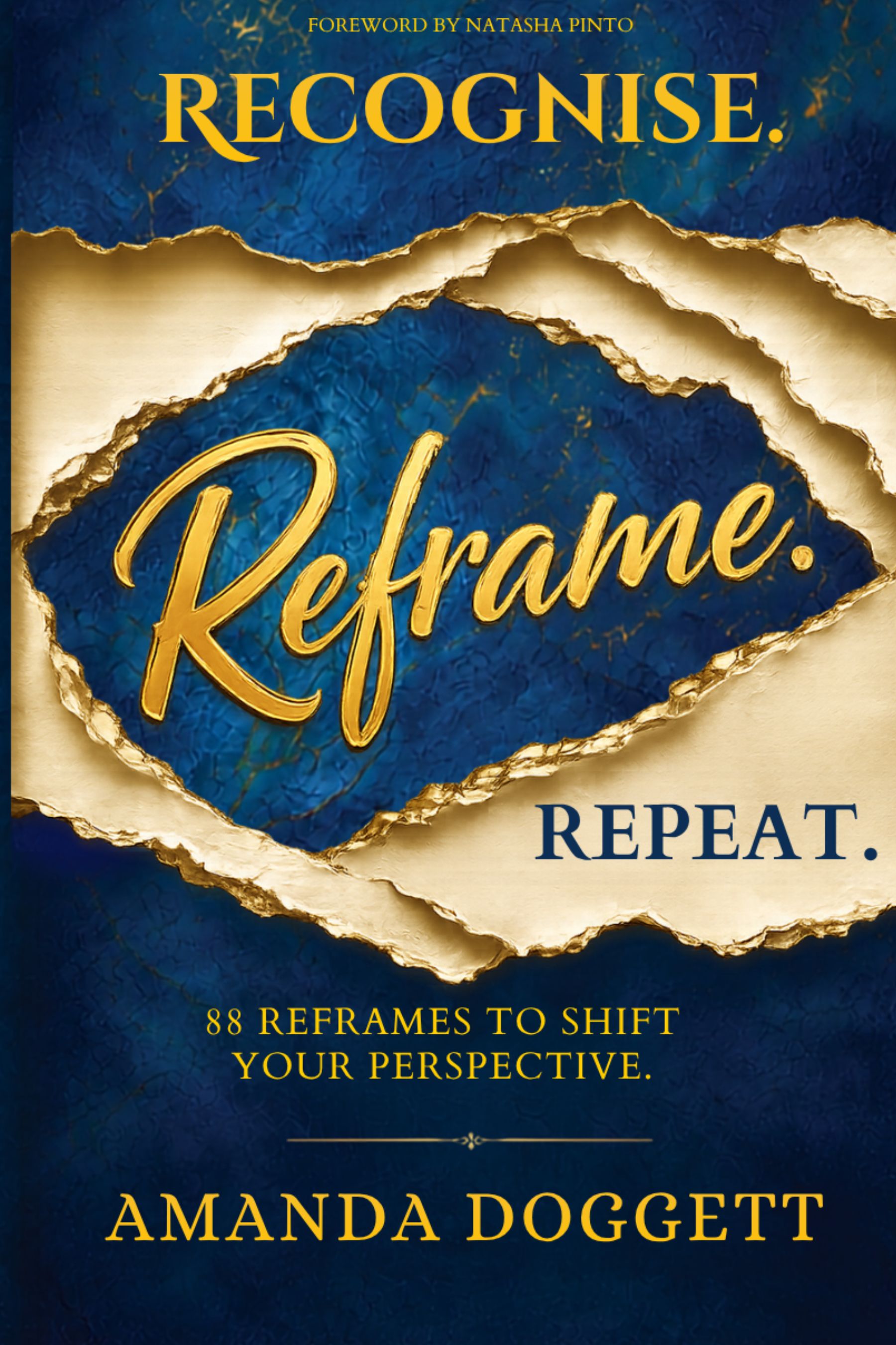 88
88Start with the book
Recognise. Reframe. Repeat. contains 88 short reframes for the everyday thoughts that can quietly keep us stuck.
Open the book anywhere. Read one reframe. Consider how it applies to your situation. Then use it as inspiration to create one of your own.
The book can help you understand what a balanced reframe sounds like before you begin practising independently.
The Reframe Challenge community
Reframing becomes easier when you see how other people question and rewrite their everyday thoughts. Join the community to discover examples, share your own reframes and practise the three-step method with others.
Caught an unhelpful thought today? Recognise it. Reframe it. Share what changed.A place to begin
Download five examples from Recognise. Reframe. Repeat. and use them as inspiration for your own challenge.
Existing subscribers stay on the same list. No duplicate list is created.Delivered by MailerLite. Useful words only; unsubscribe whenever you like. Privacy policy ↗
Please read
The Reframe Challenge and Recognise. Reframe. Repeat. are educational and personal-development resources. They do not provide therapy, diagnosis, psychological treatment or individual mental health advice.
Reframing is not intended to replace appropriate medical or mental health care. It may not be suitable as a stand-alone strategy for people experiencing persistent, severe or acute mental health concerns.
Please seek support from a qualified health professional if your thoughts or emotions are causing significant distress, affecting your ability to function or creating concerns about your safety or the safety of another person.
If someone is in immediate danger or requires urgent support, they should contact local emergency services or an appropriate crisis support service.